

Refrigeration
Compression Chillers: How They Work
How do compression chillers work? Let's take a detailed look at how this is done, along with some basics for its operation.



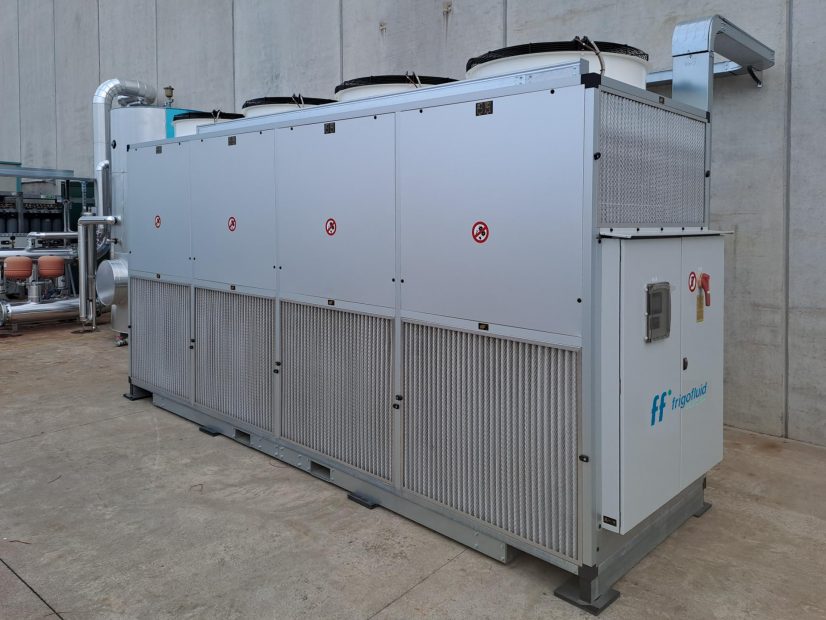
They are widely used to cool buildings, industrial plants and even electronic equipment, as they are among the most efficient devices for heat dissipation and because they can reach very low outlet fluid temperatures. But how do compression chillers work?
Basically, the chiller, or compression chiller, is a machine that uses a mechanical compressor to compress and pump a refrigerant fluid through a cooling cycle.
Let us look in detail at how this is done, along with some basics for its operation.
Let us assume that both compression and absorption chillers have the purpose of removing heat from water, air or other fluids. The difference naturally lies in the cooling mechanism used for this purpose.
In general, most industries use compression chillers to refrigerate their fluids. However, absorption chillers or chillers have their own particular use: trigeneration.
Let us now turn to the operation of compression chillers.
This type of heat dissipation device operates by means of a refrigerant gas: the process fluid to be cooled (water, water and glycol, or other) comes into contact with this gas and gives it heat. In turn, the refrigerant will have to dispose of the heat “received”: this through the thermal and mechanical work of the various components of the chiller.
It is therefore clear that there are two circuits to be considered:
Let us see how both work in detail.
As a starting point, we consider the process fluid that has heated up as a result of its use in industrial lines. Therefore, it must be cooled by the compression chiller.
However, this last step will become clearer after considering the next chapter.
Instead, here is how the compression refrigeration cycle, which characterises the refrigerant gas (or ‘fluid’), works.
From what has been said so far, it is clear which is one of the main components of this system and which makes the refrigerant ‘do its job’: the mechanical compressor. So much so, in fact, that we very often refer to the refrigeration of process fluids (which does not take place via the aforementioned absorption) as “mechanical cooling”.
This is in contrast to other forms of process fluid cooling:
Two screws make up the interior of the compressor. They are positioned to progressively move the refrigerant from the suction area to the discharge area: the volume decreases, the gas is compressed. This is, as can be seen, purely mechanical work.
As we have seen, passing through the condenser, the refrigerant gas condenses and gives up heat to the system. It is then necessary to understand how the system disposes of this heat.
So, the difference between these two types of chillers, or chiller, is quickly stated:
Of course, both systems have advantages and criticalities.
A water system is undoubtedly more efficient and uses less electricity. In addition, it can reach temperatures even far below zero, but naturally requires the support of technologies such as a cooling tower. In addition, the availability of the water resource must be taken into account. On the other hand, an air cooler only uses energy: in some regions of the world, it is practically an obligatory choice.
A refrigerant often used in chillers is R410A gas: a mixture of two gases (R32 and R125) which is an energy-efficient gas but also very safe in the event of leaks, as it is non-toxic and non-flammable. Also often used is the refrigerant R513A, which has a lower GWP (Global Warming Potential) while maintaining good performance.
Both of these refrigerants are fluorinated gases: consequently, according to current regulations, the refrigeration circuits of chillers that use them must be maintained by refrigeration technicians with a regular licence.
The trend is, of course, to use refrigerant gases with an increasingly limited greenhouse effect, also in line with the European Commission’s goal of climate neutrality by 2050.
We have seen some basics of how compression chillers work, through a series of components and the right choice of refrigerant gas.
Here, however, are some of the “secrets of chiller builders”…