





Mechanical Cooling: Industrial Chillers
Efficiency and performance... below room temperature
Do the fluids in your process lines need to reach temperatures below ambient? The solution is mechanical cooling, which is possible through chillers, i.e. industrial compression chillers. On the other hand, temperatures of even tens of degrees below zero can be reached.
Requirement: very low temperatures
The basic requirement that a compression chiller meets, through mechanical cooling, is certainly the low outlet temperature that can be achieved.
However, it is not the only one. If we talk about an air-cooled chiller, a further advantage is the saving of water resources, which are scarce in some parts of the world. There is no shortage of mechanisms for saving energy, which is essential for the internal processes of an industrial chiller but has become equally precious in recent years.
Tell us your needs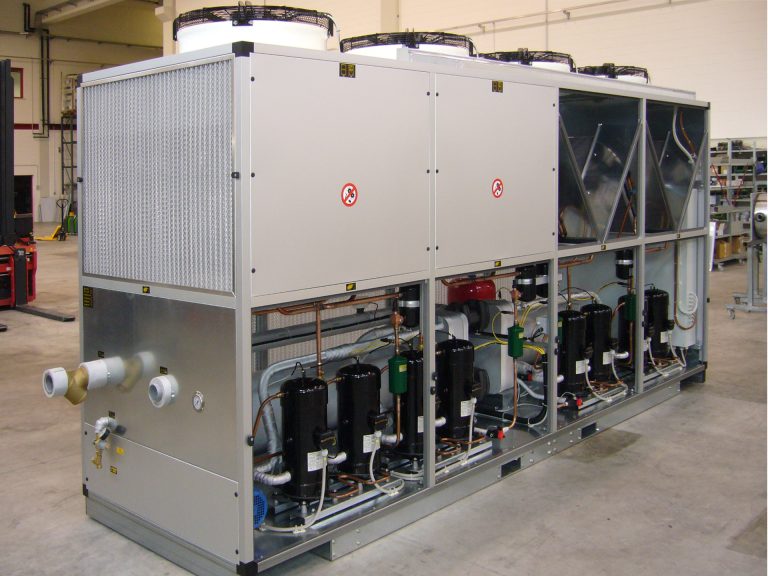
Solution: compression chillers
Compression chillers, commonly used in most industrial plants, use a refrigerant gas to dissipate heat from the fluid to be cooled. In turn, this gas uses a refrigerant circuit to dissipate this heat and continue its refrigeration function.
The compression chiller is therefore a ‘complex’ machine and these are its basic components:
- evaporator;
- compressor;
- condenser;
- lamination valve.
The mechanical compressor is a fundamental part of this cycle and is what gives mechanical cooling its name. In some cases (as in water-cooled chillers) an evaporative cooling tower can be integrated to support this heat dissipation process.
Want to learn more about how a compression chiller works?
Find out more